A City On A Hill

In 1630, eleven ships left England for the new world.  The ships carried 700 passengers, livestock, and a charter for the Commonwealth of Massachusetts.  They were Puritans seeking religious freedom and a new life. 

Before they landed, John Winthrop, their leader, articulated his vision of the society they would create.  “All true Christians are of one body in Christ,” he said, “the ligaments of this body which knit together are love.  All parts of the body being thus united…in a special relation as they partake of each others’ strength and infirmity, joy, and sorrow.”

“We must be knit together in this work as one man,” Winthrop said. “We must entertain each other in brotherly affection. We must be willing to abridge ourselves of our superfluities, for the supply of other’s necessities…For we must consider that we shall be as a City on a Hill.  The eyes of all people are upon us.”

Winthrop’s vision of America has held fast through the years.  Its fulfillment is in large part what makes the United States unique in the history of the world. America is the only nation composed of people drawn from another place. It is the only nation whose people are not connected by blood, race, culture, or original language.

One of the first acts of the Continental Congress was to pass a resolution authorizing a committee to research and devise a National Motto that would capture this concept.  The task was given to Benjamin Franklin, Thomas Jefferson, and John Adams.

Two months later, on September 9, 1776, Congress gave the new nation a name – the United States of America.  The honor of naming our country belongs to Thomas Paine, who has since been called America’s Godfather.  At the same time, Franklin, Jefferson, and Adams reported the recommendations of their committee.

They recommended “E Pluribus Unum” for a national motto – latin for “From the Many One.”  The motto was designed to remind us that out of many states – and many different people – one nation was born.

Fortunately, the assembly that was asked structure that unity contained some of the finest minds and arguably the noblest characters to have ever appeared in the New World.  Fortunately, the assembly had George Washington as its President.

The documents they developed – the Constitution and the Bill of Rights – defined the structure of our government, our citizens’ relationship to their government, and our relationship to each other.  As Americans, we are asked to balance our individual interests with the common good, our ambition with compassion, enterprise with responsibility, liberty with spirituality.

Despite the obvious success of their initial efforts, the founders of our nation continued to express concern for our unity.  “The unity of government, which constitutes you one people,” George Washington said in his farewell address, “is a main pillar in the edifice of your real independence…and that very liberty, which you so highly prize.”

At his inauguration after a bitter and partisan election, Jefferson said, “Let us, then, fellow citizens unite with one heart and mind.”  Playing the peacemaker, he reminded the contending forces “every difference of opinion is not a difference of principle.”

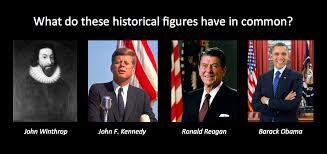
Concerns for national unity remained well into the 20th Century.  At times, Presidents John F. Kennedy, Lyndon Johnson, Richard Nixon, Jimmy Carter, George H. W. Bush, Bill Clinton, and Barack Obama all resurrected Winthrop’s vision and recalled his words; but no one took them more to heart than Ronald Reagan. 

Reagan built his political career around Winthrop’s observation.  Starting in the 1970s, Reagan began framing the story of America from John Winthrop forward. From there, he built a powerful articulation of what has come to be called American exceptionalism. 

Reagan felt “there was some divine plan that placed this great continent between two oceans to be sought out by those who were possessed of an abiding love of freedom and a special kind of courage.”  In 2012, American exceptionalism—as summarized by the phrase “a city on a hill”—became an official plank in the platform of the Republican Party.

In his Farewell Address, President Ronald Reagan recalled John Winthrop’s words one more time.  He said, “I’ve spoken of the shining city all my political life, but I don’t know if I ever quite communicated what I saw when I said it.  But in my mind it was a tall, proud city built on rocks stronger than oceans, wind-swept, God-blessed, and teeming with people of all kinds living in harmony and peace; a city with free ports that hummed with commerce and creativity. And if there had to be city walls, the walls had doors and the doors were open to anyone with the will and the heart to get here. That’s how I saw it, and see it still.”

That’s how I see it as well.  America is a rag-tag nation, built from the flotsam and jetsam, the scraps and misfits of the world.  At times the pieces don’t seem to fit and our individual interests, our determined pursuit of success and happiness, seems to overwhelm our sense of community.  But when we are tested, we have always come together; the spirit of America rises and there can be no doubt we are one people.

It is when we are challenged that we remember our true interest is a mutual interest. The doctrines that would divide us, the people that put race against race, religion against religion, class against class, and worker against employer are false and doomed to fail.

We know intuitively that everyone is needed.  Everyone can contribute.  Individually, we may only have a small piece of the puzzle but each of us has at least one piece and every piece is essential.

This is where community begins.  Community comes when people see hope where there is fear and decide to join hands, linking themselves with others in a common cause.  Community comes when people decide not to ignore a problem or run away, but to reinforce each other and take on apathy and despair.  Community comes when we realize nothing of real value can be accomplished alone.

Serving others is our common duty and birthright.  Selfishness is at the root of all moral evils.  Selflessness is the goal of human existence.

An individual has not started living until he or she can rise above the narrow confines of their personal interests to the broader concerns of humanity.  A nation cannot survive separate and apart.
Posted in Inspiration | 7 Comments

We Have Met the Enemy

I am afraid.

Not for my personal security.  I am too old and have been too close to the edge too many times to worry about that. 

I fear for my country; the country I have served my entire life, every way I can – at the U. S. Senate for twenty years, in the military during Vietnam, and in the community through various charities I helped create.

I worry about the world our children will inherit.

My concern comes from watching what’s happening around us, the daily drumbeat of disasters on the news, and thinking about them in the context of lessons I learned from two survivors of the holocaust – Viktor Frankl, author of Man’s Search for Meaning, and Henri Landwirth, founder of Give Kids the World. 

Both Viktor and Henri warned privately and publicly another holocaust was always possible.  They spent much of the last half of their lives telling us to be vigilant least it happen again. 

At the time, I didn’t see how that could happen. It is now increasingly clear we ignore that possibility at our peril. 

Gregory Stanton, the founder of Genocide Watch, has identified the stages that can cause otherwise decent people to commit murder.  He says it starts when a one group defines another as “the other.”  “They” are said to threaten “our” interests.  Discrimination and dehumanization follow, eroding the in-group’s empathy for the other group.

This leads to increased polarization and the belief that – “You are either with us or against us.”  Then true believers are asked to demonstrate their commitment.  “Enemies” are identified.  Leaders of the opposition are targeted.  Death lists are made.  Weapons are stockpiled.  Physical segregation is enforced.  “We” don’t want to live anywhere near “them,” the in-group says.  The out-group is forced into ghettos or concentration camps.  There they are easily targeted and the massacres and mass murders can begin.

History shows many of the perpetrators of these atrocities have no remorse, not because they are incapable of feeling it, but because they find ways to rationalize it.  Bob Macauley, founder of AmeriCares, helped me understand this point years ago when we talked about the genocide in Rwanda.  He described some of the horrible atrocities AmeriCares had witnessed, including Hutu men chopping up the children in their villages with machetes. 

When I asked how they could possibly do such a thing to children they undoubtedly knew, he said they rationalized it by saying they had no choice.  “It was necessary to keep my people safe,” one man said.  “Those children would have grown up to come back and kill us.”

We are not there at the moment; but we are not far from there.  You can see it bubbling up on the streets, seeping up through the sidewalk, and in the great undercurrents and tides of hate flowing back and forth just below the surface.

Let me be clear.  This is not about one side or the other.  For those who may think I am talking to the left or the right, get over it.  A reaction of that nature is just one more manifestation of how divided we have become.  It’s not about “us” or “them.”  It’s about us.

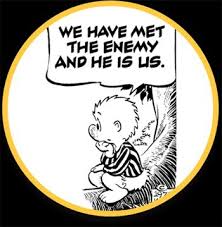
No one is exempt.  We all have to recognize our responsibility for the world we are living in.  No one has said it more clearly than the cartoon philosopher, Pogo.  “We have met the enemy and he is us,” he said.

Take a moment and consider that.  Have you ever seen our society so polarized?  Have you lost friends for political reasons?  Are there people you used to talk to that you now avoid?  When your family and friends gather are there places you just don’t go?  Do you get your information from a single source or can you switch channels back and forth without getting aggravated by what you hear?

It’s hard to tell whether the acrimony we see in our political system is a cause or an effect.  What is clear is that each side of the political divide believes the other side is evil.  Both sides see the coming election as existential.  Neither side believes it can live with other side’s success.  If the election is close, neither side will accept the outcome without question. 

Inevitably, in that case, the divide will become larger and deeper.  This is a recipe for disaster.  It will take us to a dark place the likes of which we have never seen in our country’s history.  

But there is a light out of this darkness.  It begins with the recognition that we have a choice, that America is more “bottom up” than “top down”, and that this country will be whatever we are. 

The responsibility is ours, not theirs.  The solution to all the problems on the national level starts locally on the personal level with our love for each other, the acceptance of those with differing views, and our denial of the forces that would separate and divide us from one another.  

As a child, I often wondered where hell was.  Later, I learned the word “hell” comes from the old English.  Literally, it means “to separate” or “to build a wall around.”  To be “helled” was to be shut off.  

Interestingly enough, “diabolic” comes from a word meaning “to divide.”  Diabolic forces separate us from each other and God.  In our lives they find expression in ego, anger, pride, radical religions, nationalism, racism, envy, ignorance, and greed.  These are the forces of darkness.  They divide and conquer.

By contrast, “heaven” means “harmony.”  If demonic forces divide, love unites.

Peace will not come; we will not see the best of America, until we are able to get beyond the superficial elements that divide us.  Our society will not heal until we realize the only thing that separates us from each other is the belief that we are separate.

The answer lies in the distance between saying “I am my brother’s keeper” and saying “I am my brother.”

Posted in Inspiration | 26 Comments

“I Thought We Were Passed This.”

Of all the hundreds of hours of television I have watched this week and of all the comments made by the seemingly endless number of pundits, one comment stays on my mind. 

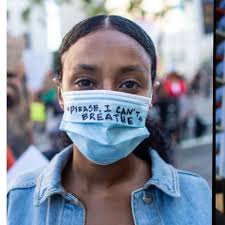
It came from Martin Luther King III as he was being interviewed on CNN last weekend.  He was asked to talk about the protests that have followed the killing of George Floyd in the context of his father’s work. 

“I thought we were passed this,” he said. 

My response was visceral. His comment resurrected a flood of memories.

One of the earliest memories was a classmate who brought a sock to show-and-tell in the sixth grade saying it had belonged to a black man who had been lynched near our small western town a few years before.  

I remembered Selma and Montgomery.

I remembered George Wallace.

I remembered Bob Moses, a man of towering integrity who was known in the civil rights movement as the first to walk into danger and the last to walk away.

I remembereded being on the Mall listening to Dr. Martin Luther King, Jr.

I remembered being on the Capitol steps watching the City burn the day after he was killed.

I remembered being on an elevator in the Capitol with the senior Senator from South Carolina who – after hearing conversations reflecting shock and sadness at Dr. King’s death – waited for the elevator to clear and said, “It’s about time someone killed that son-of-a-bitch.” 

I remembered being on Bobby Kennedy’s campaign staff and his fight for social justice.

I remembered being in the Senate gallery, watching as the Senate passed the Civil Rights Act of l964 after a dramatic 75-day filibuster dramatically broken when Senator Clair Engle, a Republican from California, too sick to speak, signaled his affirmative vote by pointing to his eye.

I remembered my surprise in light of this history when an African-American was elected to the highest office in the land.

Collectively, my memories told me we had come a long way.  So, forgive me if I too thought we were passed all this.

But as I ruminated on the words from Dr. King’s oldest son, I found a deeper meaning and a greater challenge.

Start with the obvious. It’s hard to watch the death of George Floyd. It was a crime against humanity so clear and vicious you can’t help wanting to protest.

But is what we are now seeing the beginning of the end or the end of the beginning?

“Our reliance is in the love of liberty which God has planted in us,” President Lincoln said.  “Our defense is in the spirit which primed liberty as the heritage of all men, in all lands everywhere.  Destroy this spirit and you have planted the seeds of despotism at your door.”

Lincoln’s words are a reminder that liberty is not just an idea, and abstract principle.  Liberty is power – specifically the power to act.

Consider again the words of Martin Luther King III in this context.  Is it enough to protest?  Shouldn’t we be passed that place?

When will we accept our responsibility for the world we see?  When will we accept ownership?  Most important, now and always, what are we going to do about it?

Apathy is the enemy.  The sad truth is that the actions of this Administration so objectionable to so many would not have happened if many of the people – particularly the young – who are now marching had taken the time to vote in 2016. 

Until the energy we see on the streets is dedicated to mobilizing, registering, and getting out the vote, nothing will change.  If we truly want justice, if we want America to live up to her promise, we must make it happen. 

We must be the change we seek.  Ultimately, America is and will always be whatever we are.

Posted in Inspiration | 3 Comments

Viktor Frankl

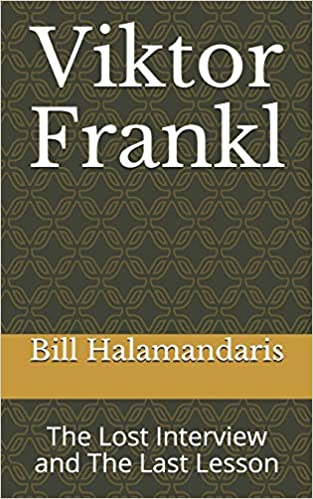
(Viktor Frankl was the author of 39 books, including Man’s Search for Meaning.  In l985, he sat down with me for a rare interview.  Long lost, this interview has been found and is printed here along with a paper about the end of life written by Frankl as he approached the end of his life.  A excerpt from this new book, published by Amazon, is reprinted below.)

•••

Once in a quiet moment Viktor told me how he found his path, how he came to be in the concentration camps, and the value of that “abyss experience.”

“When the Nazis came to power,” he said, “I was the head of the neurological department of a Jewish hospital in Vienna.  Anti-Semitism was increasing daily and my family and I could see what was coming.  Like many people, we began preparing to get out.  I applied for a visa to come to America where I could continue my work.

“At the eleventh hour as the Nazis were closing in, the U.S. Consulate informed me a visa had been granted for me to emigrate to the United States.  This was the moment I had anticipated for several years and I rushed down to the consulate with great excitement.  My enthusiasm fled when I realized the visa was only valid for one.  I was confronted by the fact that if I escaped to America, I would have to leave my parents behind.”

In despair Viktor left the embassy and walked in a daze to a park nearby.   Covering the yellow Star of David he was compelled to wear on his chest, he sat on the park bench in agony wondering what to do.

“On one hand,” he said, “was safety, the opportunity to work, and nurture my ‘brain child’ — logotherapy.  On the other hand, there was the responsibility to take care of my parents by staying with them in Vienna and, rather than leaving them to their fate, share it with them.”

What would his parents do if he left, he thought.  What could he do if he stayed?  Would it make any difference to them or would all be lost?

“At best, if I stayed with my family, I would have the opportunity to be with them and protect them from being deported but who knew for how long before the Gestapo came for us all,” Viktor said.  “If I stayed, my work and theories would perish with me.”

Viktor said he sat there, meditating and praying, for more than an hour.  Finally, he realized he could not resolve the matter and got up to go home.  As he left, he thought that if there ever was a time that a man could use a sign from God, this would be such a time.  The issue was beyond human resolution.

Almost immediately upon entering the apartment he shared with his family, Frankl noticed a stone, a piece of marble, on the mantle over the fireplace.  He called his father and asked him, “What is this and why is it here?”

“Oh, Viktor,” his father said with some excitement.  “I forgot to tell you.  I picked it up this morning on the site where the largest synagogue in Vienna stood before the Nazis tore it down.”

“And why did you bring it home?” Viktor asked. 

“‘Because I noticed that it is part of the two tablets whereon the Ten Commandments are engraved – you remember, above the altar?’ my father said.  In fact, one could see, on the piece of marble, one single Hebrew letter engraved and gilded.  ‘Even more,’ my father said, ‘I can tell to which of the Ten Commandments this letter refers because it serves the abbreviation for only one.’” 

“I looked at it and had my answer,” Viktor said.  “It was the commandment that says, ‘Honor thy father and thy mother.’  At that moment, my decision was clear.  I gave up my visa and stayed in Austria.  A few months later, the Gestapo closed the hospital.  My whole family was arrested and taken to the concentration camps.   My mother died in the gas chamber of Auschwitz.  My brother died in a coal mine near Auschwitz.  My father, weakened from starvation, finally succumbed to pneumonia.” 

The only satisfaction in this was that Viktor was able to visit his father in his barracks and be with him in his final hours.  As a physician, he could not help but notice the terminal lung edema setting in.  He saw his father in pain.  He heard his struggle for breath and knew when it was time to use the single ampoule of morphine he had smuggled into the camp. 

Viktor waited and watched until the morphine worked.  When it showed relief he asked his father if there was anything more he could do for him.  They talked for a moment until his father fell peacefully into the sleep Viktor knew would be followed by death. 

As he left, Viktor said he knew he would never see his father again, but rather than sadness, he found himself experiencing happiness to a degree he had never known before.  There in the concentration camps, the most miserable of experiences, Viktor found his greatest joy.  He had honored his father.  He had been there for him and stayed with him to the last and as a result had been able to ease his father’s pain.

At the same time, in ways he could not have anticipated, the decision to enter the concentration camp advanced his career and established the credibility of his work.  For it was there that Frankl found the laboratory to test and prove his theories. 

Freud believed that if you subject the mass of humanity to deprivation, human differences would be minimized and man would be reduced to fundamental desires, animal instincts, and a single-minded pursuit of survival at all cost. 

“Freud was spared to get to know the concentration camps,” Viktor observed.  “But we who were there saw not the uniformity he predicted.  People became ever more different when confronted by such a tragic situation.  They unmasked their real selves – both the swine and the saint.

“In truth, I found it was the orientation toward a meaning to fulfill in the future – after liberation – that more than any other factor gave people the greatest chance to survive even this abyss experience.  It is evidence of what I have come to call the self-transcendent quality of a human being – that is, a truly human being is never primarily or basically concerned with himself or herself, or anything within himself or herself; but rather is reaching out of themselves, into the world, toward a meaning to fulfill or another human being to love.”

Posted in Inspiration | 12 Comments

What the Coronavirus Teaches Us

This is hard.

We are being asked to do the things we have never done before.

Don’t touch.

Stay away from family members.

Avoid hospitals or nursing homes – no matter how sick or lonely your loved ones are.

Don’t visit friends.

Stay home.

Don’t work.

Avoid strangers. 

These things are difficult because these things do not come naturally to us.  They are contrary to human nature. 

It’s like the world has been turned upside down.  How do we make sense of it?

I’m not sure we can; but if there is an answer other than what history will provide it probably comes in an observation made by my friend, Tim Love.

Tim is the former Vice Chairman of Omnicom Group, a leading global advertising and marketing company.  He retired in 2013 as CEO of the Asia Pacific, India, Middle East and Africa regions.  These positions gave him a rare worldview.

When facing a difficult problem, Tim has always advised me to – “Think like the sun.”  It takes a long lens to see beyond the moment.

If you look at what’s happened that way, you can’t help wondering why the virus arrived when it did.  You can’t help wondering why it arrived the way it did and why we have responded the way we have.

Is it an accident that it comes at a time when the world is becoming increasingly polarized? 

Is it an accident that it comes when our country is so divided?

Is it an accident that it comes at a time when our political system seems so dysfunctional? 

Is it an accident it comes when the media has been so discredited half the population doesn’t know who to believe?

Is it an accident that it comes when confidence in our institutions has been eroded and the fundamental role of government is in question?

The most obvious lesson is how small the world really is.  In four months, the Coronavirus has infected nearly every nation in the world. 

The virus doesn’t see the lines we have drawn on the map.  It doesn’t care about our racial distinctions or religious divisions.  All humanity is at equal risk.

The second great lesson is a reminder of how interdependent we are.  The level of our attachment and degree of our mutual dependence is more evident every day.

Third, what we are being asked to do is to help ourselves by helping others.  This is the “enlightened self-interest” Alexander de Tocqueville first noted as so essential to democracy.   It is part of our social compact.

The social compact is the fabric that binds us.  We see it most clearly on the highways.  The only way we can get from here to there safely is if everyone stays in their lanes.  Sure there is the occasional self-centered cretin who blows through traffic at great speed or drives on the shoulder to avoid a traffic jam, but almost unconsciously most people consider others, obey speed limits and follow the rules. 

So it is now.  We stay away from people not for ourselves but because of our concern for others.  The further apart we are, the more we realize how important it is to be together.

“No Man Is An Island,” John Donne said.  COVID-19 is a hard way to learn that lesson.

Donne’s poem expressed his belief that human beings do badly when isolated from others and need to be part of a community in order to thrive.  His poem was written in 1624, but it could not be more relevant to this moment.  It reads as follows:

No man is an island entire of itself,
Every man is a piece of the continent,
A part of the main.

If a clod be washed away by the sea,
Europe is the less,
As well as if a promontory were,
As well as any manor of thy friend’s,
Or of thine own were.

Any man’s death diminishes me,
Because I am involved in mankind.
And therefore never send to know for whom the bell tolls;
It tolls for thee.

Posted in Inspiration | 6 Comments